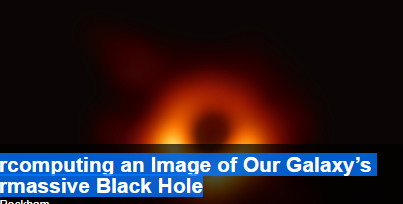
A supermassive black hole call Sagittarius A sits at the center of the Milky Way. Now, for the first time, we can see it. The resulting direct image of Sagittarius A*, reveale this week. Made possible by the Event Horizon Telescope (EHT) array and the Frontera supercomputer at the Texas Advanced Computing Center (TACC).
The EHT array includes a selection of eight radio telescopes around the world, spanning sites from Spain to Antarctica.
Our Galaxy’s Supermassive Black Hole
This array was conglomerate with the distinct purpose. Directly observing a black hole for the first time ind, in April 2019. they did just that, obtaining an image of a black hole at the center of the galaxy M87, around 55 million light-years from Earth.
Sagittarius A* (shortened as Sgr A) is much closer—a mere 27,000 light-years away. However, Sagittarius A is more than a thousand times smaller and less massive than M87. Sagittarius A posed other challenges that made capturing an image much more challenging than the same task was for M87*.
“The gas in the vicinity of the black holes moves at the same speed. Department of Astronomy and the Data Science Institute of the University of Arizona. “But where gas takes days to weeks to orbit the larger M87. The much smaller Sgr A* it completes an orbit in mere minutes. This means the brightness and pattern of the gas. A was changing rapidly as the EHT Collaboration was observing it—a bit like trying to take a clear picture of a puppy quickly chasing its tail.”
...............................................
The EHT array captured an enormous amount of data of this moving target, but understanding that data and distilling it into a legible image was another matter entirely. To help, the researchers turned to supercomputing, building the largest-ever simulation library of black holes. These models—based on the known physical properties of black holes, general relativity, magnetohydrodynamics and more—were aimed at simulating what the EHT would see based on researchers’ best understandings of what black holes should look like to such instruments.

