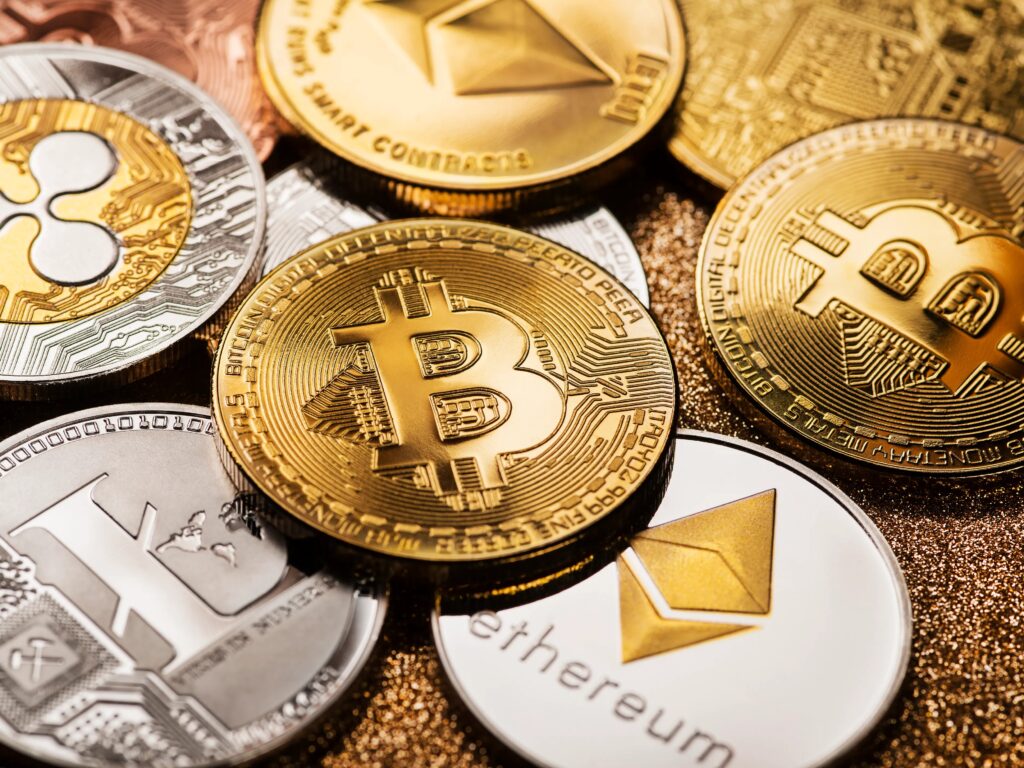
2022 started complicated for cryptocurrencies. In the case of market leader Bitcoin, it has failed to recover from the slump it has suffered since last year when it peaked at $69,000. But what happened in the market during January?
2022 started complicated for cryptocurrencies. In the case of market leader Bitcoin, it has failed to recover from the slump it has suffered since last year when it peaked at $69,000. Today it remains below $40,000 and there is no sign of a bullish rally that will take it out of its support zone. How did the top cryptocurrencies perform in January?
Solana (SOL)
Solana is a Layer 1 blockchain whose objective is to promote new generation applications to achieve greater scalability and make them accessible to everyone. It uses the PoH protocol, through which the network creates a time stamp, leaving a record of all events. Among its most outstanding characteristics are: its transactional speed, more transactions per second, low cost per transaction, decentralization and global scale. Despite the gains and rally in 2021, it was the first worst performing cryptocurrency (-44.6%).
Terra (LUNA)
Terra is a blockchain project developed by Terraform Labs, which seeks easy access to the creation of stable cryptocurrencies, that is, that do not vary in price (stablecoins) and whose price is anchored to that of currencies known as the dollar. . Its native token, LUNA is among the fastest growing in 2021 but has not started 2022 on the right foot. In January, it became the second worst performing cryptocurrency (-43.6%).
Avalanche (AVAX)
Avalanche is an open and programmable smart contract platform for decentralized applications. Like Cardano (ADA) and Solana (SOL), among others, Avalanche aims to compete with the Ethereum blockchain for the development of smart contracts. However, unlike the two mentioned blockchain, Avalanche has the advantage of its compatibility with the Ethereum Virtual Machine (EVM). In other words, the Avalanche Blockchain can host the applications developed in Ethereum, but with more advantages. In January, it became the third worst performing cryptocurrency (-38.4%).
Polkadot (DOT)
Polkadot is a relay mechanism that facilitates authenticated transactions from one blockchain to another. It provides shared security that is the same for all members, regardless of the protocol they use. In this case, one of the cryptocurrencies with the highest growth last year, reaped a negative return of (-31.4%).
Ethereum
Ethereum works as an open source platform based on blockchain technology. This blockchain is hosted on many computers around the world, so it is decentralized. The ethereum blockchain is similar to bitcoin in that it also functions as a record of transaction history. The second market capitalization cryptocurrency closed January with a negative return (-28.7%).
Binance Coin (BNB)
Binance Coin is the official cryptocurrency of the crypto exchange or exchange house Binance. The cryptocurrency is based on the Ethereum blockchain and works in a similar way. The coin was born to support transactions within its own Binance platform, so it cannot be purchased on other platforms. The cryptocurrency is located in the top 10 and like its peers, it closed with a negative return (-27%).
Cardano (ADA)
Cardano, due to its qualities, seemed to be a reasonable alternative for those who wanted to invest in cryptocurrencies. It is a viable alternative to Bitcoin and Ethereum. One of the reasons why it is presented as an alternative was. Because of the high yield it managed to harvest in 2022. However, despite an initial rise of 10% at the beginning of 2022, it closed January in negative territory (-22.4%).
Featured
Despite the drop in prices, not all market segments are losers. The stablecoin or stable currencies benefit from this price drop. However, investors seem to be moving from risky assets to stablecoins at a fast pace. Stablecoins are cryptocurrencies designed to replicate the value of currencies such as the dollar or the euro. In other words, one of these assets will always be worth the value of a dollar or a euro at the time of its purchase or sale. Unlike currencies such as Bitcoin or Ethereum, the volatility of stablecoins is much lower since it always follows the value of the currency to which it is tied. In Argentina, the best known and usually offered on exchanges are DAI and USDT.
However, the two stablecoins that are in the top 10 of the market, USDC and USDT managed to avoid losses (0.0%) in investment in a market that faced heavy blows during January. In the case of USDC Coin (USDC) it is a cryptocurrency link to the United States dollar (USD) that can be manage on various platforms such as Ethereum, Stellar or Solana. In this case, its essential difference is that it is link to fiat money.
What cryptocurrencies have ahead in February
For months now, bitcoin and cryptocurrency companies have been demanding clarification of the regulatory framework for their industry. It seems that February will be the month in which this will be decide, since the White House is preparing an initial regulation strategy that will possibly be present in February. The US Joe Biden administration is preparing an executive release to regulate cryptocurrencies in the coming month of February, Finance Magnates recently reported.
The order is expect to bring an initial strategy that assesses the risks and opportunities of digital assets. In the process of preparing a draft, it is report that the first will be present to US President Joe Biden in the coming weeks. The regulation of cryptocurrencies is complicate in the United States at a time. When Bitcoin and Ethereum are consider commodities and any investment product relate to them is being supervise by the Commodity Futures Trading Commission (CFTC). ). On the contrary, the situation is different for other cryptocurrencies.

