The economically weaker section (EWS) is a section of Indian society that is unreserved and has an annual family income of less than 8 lakh rupees. This category includes people who do not belong to the caste categories of ST/SC/OBC and do not already benefit from reservation benefits.
The government of India implemented a 10% reservation for people who do not fall into the ST/SC/OBC categories but fall into the unreserved category and meet the economically weaker section criteria.
The Indian government implemented a 10% reservation for people who do not fall into the ST/SC/OBC categories but belong to the unreserved category and meet the conditions required for being from an economically disadvantaged section of the population.
The general category candidates who are eligible for the economically weaker section reservation come from the general category and can now benefit from a 10 percent reservation if they meet the requirements to be classified as such.
Eligibility Criteria for EWS Category
The Union Council of India approved a 10% reservation in government jobs and educational institutes for the economically weaker section or EWS of the general category in 2019. This reservation was decided to be in addition to the mandatory 50 percent reservation for the ST/SC/OBC categories, in order to ensure that the reservation under the economically weaker section, or EWS, does not affect these existing reservations.
If you are an aspiring government job seeker or a student aspiring for admission to your dream institute who falls into the general category, you can enjoy this 10% reservation under the economically weaker section or EWS, provided you meet the eligibility criteria, which are as follows:
- You must be in the general category, which means you cannot be from the SC/ST/OBC categories, which already have reservations, or from the MBC category in Tamil Nadu.
- The annual family income should not be more than Rs. 8 lakhs. An annual income of more than Rs. 8 lakh cannot be considered economically weak, and thus does not fall under the economically weaker category (EWS).
- If your family owns agricultural land, it should be no larger than 5 acres.
- If your family owns a residential flat, it should not be more than 1000-square-foot or larger.
- If your family owns a residential plot (in notified municipalities), it should note be more than 100 square yards or more .
- If your family owns a residential plot (except in notified municipalities), it should not be more than 200 square yards.
Definition of “Family” in accordance with EWS Reservation rules?
Family is defined as follows for the purpose of this reservation:
- The person who is looking for a reservation.
- His or her parents
- His/her siblings under the age of 18.
- His/her spouse and kids who are under the age of 18.
When determining eligibility for EWS reservations, the family’s land or property in different locations should be combined.
Difference between EWS and OBC Category
Reservations for the OBC can be made in the Other Backward Classes section’s non-creamy layer section.
They are entitled to a 27 percent reservation on the available space.
People of the ‘General’ class (those who do not belong to the OBC, SC, or ST) with annual household incomes below Rs. 8 lakhs are eligible for the EWS benefits. There are 10 percent reserved seats for them out of the total number of seats available in the venue.
There will be a separate (lower) cut-off for EWS candidates, in the same way that there will be separate (lower) cut-offs for OBC, SC, and ST candidates.
In the matter of number of attempts and maximum age for applying, there is no other relaxation.
Among the other differences between EWS and OBC reservations is that, the income of the spouse is not taken into account when calculating the income of the family for reservations in OBC candidates. EWS reservations, on the other hand, include it as a standard option.
What is an EWS Certificate?
EWS certificates are income and asset certificates issued to citizens from the economically disadvantaged sections of society (EWS category under General category).
Candidates must essentially produce a valid EWS certificate issued by the competent authority to claim the benefit of 10% EWS reservation in any govt. job or admission to higher education.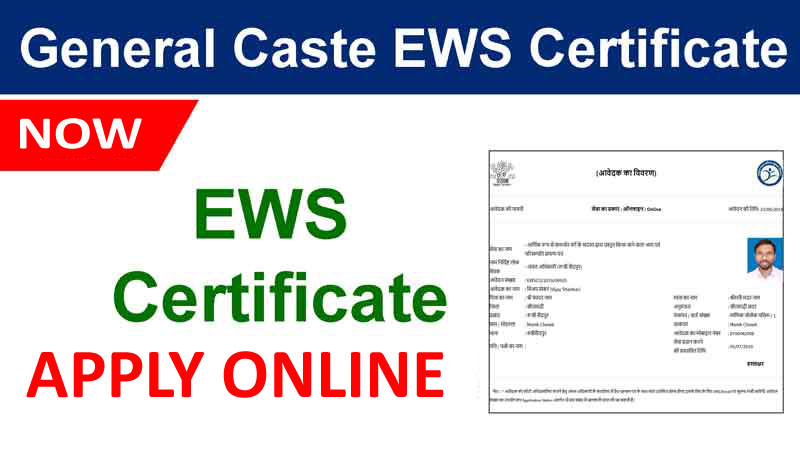
EWS Certificate Application Process
The EWS certificate application can either be submitted through offline or online medium. It is completely dependent on the State government. To apply online, go to the issuing authority’s official website, click on the relevant link, and follow the instructions. States such as Andhra Pradesh offer an online application process that allows citizens to easily submit their applications .
In the case of offline applications, the form must be picked up from the authorities responsible for issuing them.
They can also obtain the application format by visiting the official websites. This section also includes a link to the application form. They must print the application form and fill in all of the requested information. They must be cautious when entering information into the form.
The format of the EWS certificate provided by the Government of India is the same throughout the country.
You Might Also Like, Improve Your Knowledge with PhD Thesis Writing Services UK
EWS Certificate Application fees
Applicants also have to pay a small fee to apply for the job. The application fee is determined by the authority issuing the EWS certificate as well as the State Government. It simply means that the application fee will not be uniform across all states.
Documents required for EWS Certificate
Applicants must include all required documents with their application form. They must bring the following documents and information with them when filling out the application form:
- Aadhaar Card
- Id Proof
- Affidavit/Self Declaration
- Land/property documents
- Domicile Certificate
- Passport-sized photograph
- Other relevant documents
The above-mentioned list of documents varies by state, depending on their rules. As a result, applicants should go to the EWS certificate issuing authority and gather all of the necessary information.
Validity of the EWS Certificate
Certificates of income and assets will be valid for a set period of time. The designated authority of the states determines the validity of the EWS certificate. The validity of an EWS certificate, on the other hand, is generally one year from the date of issue. Before using the EWS certificate for admission or recruitment, applicants must ensure that the income certificate is valid.
For more information on the certificate’s validity, the individual should contact the issuing authority of the relevant state/UT.

