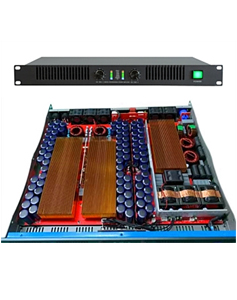
The Digital Power Amplifier Exporter has some unique qualities and overcomes inherent shortcomings because it functions entirely differently from the conventional analog power amplifier.
1. Overload capacity and power reserve
Compared to analog power amplifiers, digital power amplifier circuits have a much higher overload capacity. When a power amplifier tube is overloaded, it operates in the saturation zone, harmonic distortion manifests and the degree of distortion rises exponentially while the audio quality rapidly deteriorates. The digital power amplifier is constantly in the saturation and cut-off zones during power amplification. As long as the power amplifier tube is intact, there won’t be a rapid rise in distortion. Also, you can prefer Clock Oscillators that is also preferable equipment for digital circuits.
2. Matching of the power amplifier and speaker
The load size (speaker), when pairing speakers with different resistance values, will impact the working state of the analog power amplifier circuit due to the considerable internal resistance of the power amplifier tube in the analog power amplifier. The digital power amplifier’s internal resistance is not greater than 0.2. (the internal resistance of the switch tube plus the internal resistance of the filter). Compared to the load (speaker), the opposition (48) is negligible. Therefore, there is no speaker matching issue.
3. Temporary intermodulation distortion
All analog power amplifiers use negative feedback circuits to maintain their electroacoustic indicators. A phase compensation circuit is used in the negative feedback circuit to suppress the parasitic oscillation, which will result in transient intermodulation distortion. We can prevent temporary intermodulation distortion by the digital power amplifier’s lack of an analog feedback circuit during the power conversion process.
4. Sound and image positioning
There is typically a phase difference between the output signal and the input signal for analog power amplifiers. Additionally, phase distortion differs depending on the output power. Since there is no phase shift and perfect phase coherence between the input and output signals thanks to digital signal amplification, the sound image positioning is precise.
5. Production debugging
At all operating points, analog power amplifiers have debugging issues, making mass production difficult. The majority of digital power amplifiers are digital circuits, making them particularly well-suited for mass production and able to function normally without debugging.
Advantages Of Digital Amplifiers
· Compared to analog amplifiers, digital amplifiers are less expensive, use less power and produce less heat.
· The weight of digital amplifiers is minimal.
· They don’t need any unique setup and are simple to use.
· You can also take advantage of low noise levels and high gains without distortion.
Limitations of Digital Amplifiers
· The sound quality isn’t as natural as what an analog amplifier would provide.
· Without replacing parts, there is no simple fix if something goes wrong.
Benefits of Analog Amplifiers
· They produce a sound that is more soothing to the ears and clearer. They are also less expensive to maintain and repair.
· They can easily operate with both analog and digital sources that have DACs.
Limitations of Analog Amplifiers
· They cost more than digital amplifiers.
· They are susceptible to saturation and distortion.
How does Digital Amplifier Work?
The digital input from the source, typically in linear pulse code format, is digitally converted by the digital amplifier to a Pulse Width Modulation (PWM) format. To prevent the original audio signal by using a high voltage signal and the pulse width modulator. The timing and alignment of the signal must be kept constant throughout the transfer for this to be accurate. The output signal is synthesized on the speaker terminals to further reduce background and mechanical noise.
True digital amplifiers can now be bought at a fair price, thanks to recent developments in audio technology. The production could be in bulk quantity without compromising quality by using just a few microprocessor chips.
Compared to the conventional analog-based circuit, digital amplifiers offer a number of benefits, including high efficiency, fine detail, noise immunity, and the ability to configure the system. Additionally, since the audio processing design is now primarily focused on software, changes can be there more quickly with less impact on the design schedule. Because of these benefits, the digital amplifier has advanced considerably in just a few years. It is to overtake traditional audio amplifiers as the industry standard within the next five to ten years.
Gpro Audio Equipment is the well-known Chine Sound System Exporter delivering the best quality sound systems throughout the globe. Not only is their price reasonable, but the components are top-quality. Also, you can prefer Clock Oscillators that are good for your digital amplifier.

